I like modernism. It is quite a strong feeling. I've always found the contemporary forms of buildings attractive and the argumentation of Loos on redundancy of ornaments in architecture convinces me as well.
Das Looshaus am Wiener Michaelerplatz: http://www.phwien.ac.at/
I like the oeuvre of Le Corbusier as well. I visited many of His buildings and I find them very convincing. The life in Unite d'Habitation at Marseille is quite agreable - regard yourself.
Pay attention please at the care towards the maintenance of building - vide way of conservation the door frames and the way to keep the floors tidy.
The early modernist housing estates are just genial place of living. Let's look at the Montwiłł - Mirecki neighbourghood in Lodz.
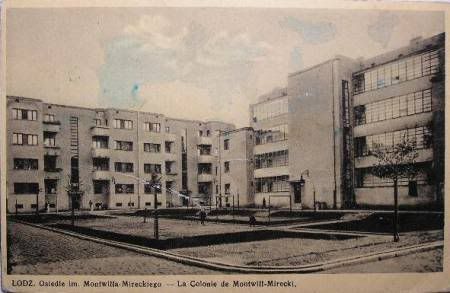
source: http://i204.photobucket.com/
The distibution of law blocks of flats, the inside courtyards, beauty of architecture and the approximity of greenery - all this forms great environment for living and social relations. I'm convinced as I used to live there for a couple of years. The cosiness is also supported by different width of passages and streets, distribution of services and - what important and interesting as well - fences in form of brick walls, but with the open passages.
There are many people who like modernism neighbourhoods of small scale, e.g. Teofilów or Radogoszcz West in Lodz. With many trees, facilities, playgrounds, and of small scale of constructions and spaces inbetween the blocks. Because these places are cosy and nice to live in. Even if the buildings maintenance needs some additional efforts.
Also Le Corbusier in the realised project of the town renounced of the former theorethical concepts of gigantesque towers. Chandigarh - also called a beautiful city - consists of many distinquished units of theirs own infrastructure, including schools, kindergardens, services.
The forms of constructions do not overwhelm - they may incite enchantment. Because of the detail, colours, forms, propotions, harmony. They find the admirers and are accepted.
It is difficult to accept the wrong solutions. Badly done, of materials of poor quality, not properly maintained and neglected. Overscaled. The blocks of flats produced in a mass in the factories, distibuted - as it was said then - according to the crane rout. To enable easier work of the crane. Not for people convinience. Without infrastructure, without services. Or the neighbourghood where new block where introduced to make former project denser. The conclusion comes to mind and seems evident - good things defend themselves. The only small reflection - verification lasts long and usually costs a lot.
Tuesday, December 29, 2009
Sunday, December 27, 2009
Ideas in urban planning may occur detrimental
The ideas which at the very first glimpse seem great may occur detrimental. An example of such an idea became the district Le Mirail in Toulouse erected in 60-ties XX century according to the design by George Candilis - one of the associates of Le Corbusier and successor of his ideas. At the beginning the argumentation seemed extremely attractive..
Look at the link: http://www.ina.fr/art-et-culture/architecture/video/I07110334/toulouse-le-mirail.fr.html
Traditional Place de Capitole in center of Toulouse is crowded with cars from the early afternoon. The parking place takes the whole surface of the square:
This as well as the following photos go from the film cited above which explains the design ideas and which was realized with the participation of the project author Candilis. The same as the ideas which are cited here.
That's why in the new quartier Toulouse le Mirail the car movement will be in the durable way separeted from the pedestrian movement. We do not want the squares and piazas to become taken by cars, we want them to be destined for people.
That's the reason of creation of the continouous wall of buildings which separates the two worlds - the world of people and rest and the world of cars and work:
The linear center of Toulouse Mirail is accompanied by linear drawing of formerly existing green areas.
View of the whole of the project.
And the model of future constructions. Buildings in the form of block of flats of huge hight and length. Housing the appropriate number of flats - the same as in the tenement houses of the traditional city.
All these beautiful ideas and gorgeous aims were not realized. Or worse - the project had been accomplished and the effects occured different than the assumtions. The ideas of Candilis - the designer of Toulouse le Mirail were just fiction.
The film below is a series of photographs made in 2002, when the revitalisation of the quartier was decided as well as the restoration of the "scale of the city". The decision was followed by demolition of the important part of existing blocks of flats. The reasons for demolition: non-human scale, environment impossible to change and to reconvert into more humanitary one. The social problems: exclusion, crimes, sense of danger, drug-addiction, which took place in the quartier were also significant.
Bellefontaine - Etat des lieux en 2002
Załadowane przez: Architecture-urbanisme. - Obejrzyj najnowsze wideo
The quartier just before and during the demolitions :
Expropriations au lance pierre, d'un monde à l'autre. Part1
Załadowane przez: Architecture-urbanisme. - Gorące wiadomości
Very interesting film showing the interview with the designer of Le Mirail - George Candilis. He admits that the conceived scale of the housing had been too big and that he realised that after it was built: http://www.ina.fr/art-et-culture/architecture/video/I07113548/toulouse-le-mirail.fr.html
Below the demolition of one of buldings. The blocks which formed the barre dividing two worlds- as assumed at the very beginning: the world of cars and pedestrians, the world of work and rest - and which in reality became the walls of ghetto.
Démolition quartier Bellefontaine - GPV Toulouse
Załadowane przez: Architecture-urbanisme. - Obejrzyj najnowsze wideo
The ideas became fiction. But this is not the end of the story. The further actions which had to be undertaken in le Mirail to recover the quartier have been very expensive.
The reconversion project budget is 314 mln Euro and it is the highest budget for such project in France. It covers two main fields of activities: social and urban. The project aim is to reconstruct the traditional city in le Mirail. And the main issue - to liquidate the ghetto. The info goes from the GPV (Grand Projet de Ville) site.
The photo below shows "the street" which used to join two worlds. The photo is a cadr of film Expropriations au lance pierre, d'un monde à l'autre.
Monday, December 14, 2009
More outtakes
More outtakes from our current issue: this time, the house on Great Barrier Island designed by Paul Clarke of Crosson Clarke Carnachan Architects. The photographs are by Simon Devitt.
This one shows the house's open-air (but covered) corridor. On the left is a storage cupboard, a small laundry alcove, and a toilet. The bedrooms are on the right, with the main living area at the end of the corridor. The open-air corridor may make for a slightly chilly trip to the bathroom in winter, but Paul believes that it's important to remain connected to the elements at a holiday home, something the owners heartily agree with.
This arresting view looks along the home's eastern flank, showing its cedar exoskeleton.
This one shows the house's open-air (but covered) corridor. On the left is a storage cupboard, a small laundry alcove, and a toilet. The bedrooms are on the right, with the main living area at the end of the corridor. The open-air corridor may make for a slightly chilly trip to the bathroom in winter, but Paul believes that it's important to remain connected to the elements at a holiday home, something the owners heartily agree with.
This arresting view looks along the home's eastern flank, showing its cedar exoskeleton.TV3's Sunrise focuses on architecture
TV3's Sunrise has recently been featuring a series of great homes that have previously been seen in HOME New Zealand. We see it as another opportunity to tell people about the importance of using a good architect when creating a home, whether it be a new home or an alteration. You can see the footage for their feature on artist Michael Shepherd's home and studio, designed by Stevens Lawson Architects, at this link:
http://www.3news.co.nz/Take-a-peek-inside-a-city-home-with-a-difference/tabid/572/articleID/133720/Default.aspx
Outtakes
A lot of people are very interested in the house by Amanda Yates that features on our cover. The beauty of this blog is that it allows us the luxury of featuring extra images of it. Amanda's aim with the project was to reference early Maori earthern architecture, dwellings that were actually part of the land, and you can see here how the house on the Coromandel Pensinsula follows the contours of the land.
The way the home's interior slope meets the rock face outside is immaculately detailed, as you can see in this image (all the photographs are by Paul McCredie):


Outside, the home's roofline also follows the slope. Upstairs is a self-contained studio used by Amanda and her partner when they visit her parents, who live there full-time.
Roy from SGA Architects requested a context shot in our layout that showed the home in its location. Here is one that shows a wider view of it on its site:
The way the home's interior slope meets the rock face outside is immaculately detailed, as you can see in this image (all the photographs are by Paul McCredie):
One of the great things about the house is the way the mood of the slope changes through the day under different lighting conditions.


Outside, the home's roofline also follows the slope. Upstairs is a self-contained studio used by Amanda and her partner when they visit her parents, who live there full-time.
Roy from SGA Architects requested a context shot in our layout that showed the home in its location. Here is one that shows a wider view of it on its site:
We're back
We end this long and embarrassing silence (blogging seems so easy to start with then suddenly, it becomes difficult to think of things to say ... then you're out of the habit) with an announcement of a recent innovation: from our December/January issue onwards, we are publishing special (and hopefully collectable) subscriber-only covers.
This is the newsstand cover for our next issue, a photograph by Paul McCredie of a house on the Coromandel Peninsula designed by Amanda Yates:

And this is our subscriber-only cover, another photograph by Paul of the same house.

You'll see that we have the luxury of being a little more pure with our subscriber cover. We are no longer subject to the tyranny of the barcode, and are under less pressure to include lots of coverlines to shout from the newsstand. Hopefully it's an object that will sit more serenely on your coffee table or beside the bed.
Monday, December 7, 2009
The fourth dimension of urban design
It happens more and more often. Architecture, urban space becomes dynamic, looses the quality of being static. It becomes great, interactive screen like the Kunsthaus in Graz.
Or like in the design of Frank Gehry for Camerimage Center in Lodz, Poland, where a great wall - a screen is to present what happens inside.
Source: GW Łódź
Like in the project of metro station Wileńska in Warsaw - where a new quality is added to the underground space. The walls which are to be screens showing what is upstairs.
Source: Bryla.pl
I like very much the idea of Mood Light. The project realised in Amsterdam for the underground passages within modernist neighbourhoods . The movement as an element inducing light pulsation, and the pulsation of space. It increases the quality of space and influences the feeling of safety.
Source: Bryla.pl
We are not only the cause of light movement - we stop to feel opressed, helpless towards the wall of dark unpleasant concrete. Like in the children room, when mum turns light off. And a kid is left alone. Such interventions increase the quality of space and do not cost so much as the redevelopment of current constructions.
Interaction, movement as an element of urban design. There is a great difference between this appoach and the one presented by the current trend setters of automotive industry. I.e. like these presented on the Discovery Channel in the programme Future Cars.
Development of methods to utterly isolate humans from the outside space. To ensure a mini center of entertainment and communication within a car. So what do you prefer? There is a choice: THE CITY or a car?
Subscribe to:
Posts (Atom)


